2009-11-08

Skulls of Amy Sarkisian


Jeweled Skulls

2009-03-26

2009-03-23

Jewelry Price Inflation Continues to Moderate

IDEX Online Research: Jewelry Price Inflation Continues to Moderate
(March 23, '09, 17:02 Ken Gassman)


Suddenly, the talk on the street has been all about inflation. A year ago, inflation was very real. Then, along came a recession, and the talk turned to deflation. Since early 2009, the talk has turned back to inflation.
With interest yields declining, investors are running for inflation hedges – typically commodities. That’s pushed up the price of oil and other commodities, including gold, in the past couple of weeks.
Does anyone really know what comes next? Speculation by Wall Street suggests that inflation is real and here to stay. We probably don’t need to remind you that these are the same folks who got us into the recessionary mess we’re currently in. Do they know of what they speak? Only time will tell.
But we do know what’s happening in the jewelry industry: inflation has been cooling since mid-2008, both at the consumer level and the producer level. Only retail prices of watches continue to inch upward at a faster rate; other jewelry commodity prices have cooled, and are up minimally year-over-year. At the producer level, prices barely crept up, and the precious metals category posted a modest decline in prices.
With the sharp rise in gold prices over the past few weeks, inflation could return to the jewelry industry in 2009. Previously, we had predicted that weak demand would hold prices down, but if investors continue their run on commodities, inflation is just around the corner for jewelers.
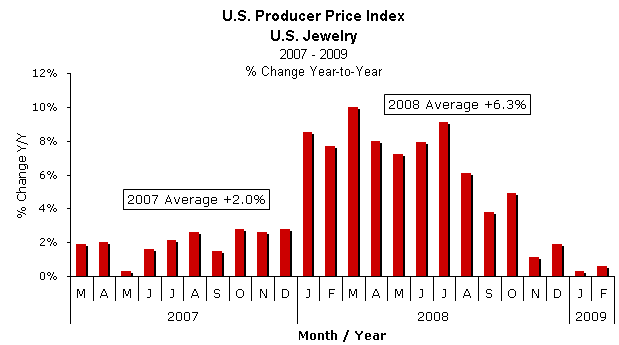


Jewelry producer prices haven’t budged upward for several reasons, including the following:


*
Retail jewelers have cut back on re-ordering merchandise. As a result, jewelry suppliers are offering a variety of price-based incentives to move merchandise into retailers’ stores. These price-based incentives are reflected in the modest inflation rate at the jewelry supplier level.

*
There is still a large backlog of high-cost goods in the distribution pipeline that suppliers need to pass on to their customers. But the good news is that the pressure is off – suppliers’ costs have moderated, so they aren’t being forced to continue to raise prices in the face of a weakening environment of consumer demand.

*
We believe that suppliers will likely hold off on any significant price increases near term for one key reason: retail jewelers simply won’t accept higher prices in the current recessionary environment.

*
Because the wholesale community is so fragmented, no one supplier has pricing power. We’ve seen some panic pricing by suppliers who are trying to move goods – at a loss, if necessary – to raise cash. In that kind of environment, any supplier who tries to raise prices will lose business.

*
Prices for both precious metal jewelry and gemstone jewelry have moderated. The graph below compares the JPPI (red bars) to inflation for precious metals (gold bars); gold had been the primary driver of precious metals inflation in 2007 and most of 2008. In January 2009, gold prices pulled back modestly, but have risen – and held steady at about $900 per ounce in February and March month-to-date. In our opinion, $900 gold has been priced into goods produced by jewelry manufacturers, and therefore producer prices aren’t likely to rise notably from current levels.

2008-05-29

Stock Market Timing

2008-03-18

"Lips" Jewelry by Enigma

Lips Jewelry by Enigma

Jewelry featuring big lips is not an easy thing to create in a classy way (in my opinion) and although these aren`t really something I would ever choose to wear I think this "lips" collection from Enigma may just have pulled the "classy lips" challenge off. Black with diamonds, white gold, and coral, this "lips bracelet" is definitely only for those looking to make a fairly bold statement and add a shot of color in an unexpected way. If that`s not you, but you`re still drawn to the lips design, maybe something in simple diamonds and white gold (like a bangle or a ring) would be more your style -- see the gallery below.


Call me crazy but I`m getting a serious "Betty Boop" vibe from this collection!

Sourse: [ enigma.info ]

...
(http://www.jewellerynews.ru)

2008-03-05

All of you who produce rough in large volume – must shift to a multi-annual sales program

Report of IsDMA MotiReport by President Ganz on Rough Conference, Tel Aviv.

Honored guests - leaders of diamond-producing states and mining companies,
I would like to talk today about the manufacturer’s critical role in your strategic decision-making, both on the national and the corporate levels.
You may ask, what’s new about that? It is clear that the manufacturers are important, for without them, there are no polished diamonds to set in jewelry! But the aspect I would like to focus on here is the distribution policy of the diamond-producing states and rough companies operating in each of these countries.

However, before addressing the issue of distribution, I would like to contest a so-called truth – something everyone says: “There is no rough” – we are told, day in and day out. The headlines report gloomy forecasts about rough production, and we often read about the search for the next large mine. I want to refute this false claim. There is rough. There is no shortage of rough.

But even more than that – we also have plenty of polished. We have tremendous stockpiles of polished. The polished diamond manufacturers have accumulated stock in an unprecedented volume of some $14-17 billion. All their funds are invested in inventory. Even if every manufacturer in the world would stop cutting diamonds today, they could still supply polished for a full year.

And so – there is rough and there is polished. So what’s the problem?
The problem is that there are not enough buyers of polished. The problem is that there are too many manufacturers that purchase rough and manufacture polished even though they have no orders. All industries, worldwide, have moved to manufacturing by demand. All industries have learned that you mustn’t manufacture for stock. Stock is expensive. When you have a customer, you manufacture. No customer? Don’t manufacture. Only the diamond industry has failed to join this global trend.

Why do we do this? Why would a manufacturer make something without knowing there’s a buyer for the product? How did we get to this situation, where 60-70% of the rough that reaches factories has no potential buyer, yet we continue to run after rough and in doing so, cause its price to soar?

We can analyze the factors involved:

1. We – the manufacturers ¬– are committed to our factories and our workers. For us, the factories are our life’s work, something we toiled hard to build up over many years. No one wants to close a factory. History shows that those who close never reopen. While we continue to provide our workers with a livelihood, we are also streamlining the work in the factories. We introduce modern, improved technology and increase production rates, but still continue to feed the same number of mouths. If today’s production is 30% more than that of the old factory – we need to supply our factories with more rough. And we do, by chasing after rough and paying unreasonable prices for it. Thus we perpetuate a worldwide situation of surplus labor and surplus manufacturing.

2. We – the manufacturers – are opening factories in diamond-producing states. We are doing so in order to enjoy direct supply of rough from the diamond-producing states and the companies committed to them. If the diamond-producing countries are now polishing $800 million of diamonds, we should be closing down factories around the world that polish that amount – $800 million. However, factories are not closing. We continue to manufacture in all locations. When we close a factory we do so with great heartbreak and only when we know there is no alternative. For as long as possible, we continue to chase after rough and cause its price to rise.

3. In order to increase our sales, we supply goods to stores on memo. The stores no longer limit the amount of goods they take on memo. In fact to the contrary – they increase it. The greater the volume of sales on memo, the greater the manufacturers’ need for stocks of polished. No store or chain promises to sell all the diamonds it takes on memo – nor even a part. And so we reach the incredible figures I cited earlier – we, the manufacturers, are sitting on a huge stockpile of polished and nevertheless we continue to seek rough and cause its price to rise.

4. The increase in polished sales in chains and stores is a mere illusion. True, in the last two years companies have reported an increase in the sale of some types of polished. However, at the same time, they have reported a decline in carat volume. In other words, in fact, less diamonds are being sold. And so, in fact, polished sales are declining. We manufacture carats and therefore, our sales are declining. In response, we want to increase sales. It is not the rough diamond producers who suffer from this situation. Nor is it the owners of chains or stores. Neither of them hold stocks of diamonds or finance them. The manufacturers are the only ones who maintain factories, pay workers and finance stock. They alone bear the consequences of the current situation. The rough traders do not owe money; their goods are sold in entirety on a regular basis to manufacturers. The diamond manufacturers have a large stock of polished goods. That is where their money is invested.

5. The diamond manufacturers are misleading themselves. They are mistaken when they apply the data at the year’s end to project sales for the coming year. The manufacturers are deluding themselves if they believe that if they turned over their inventory one and a half times this year the same will be true next year. When next year arrives and they discover that what actually increased was the store price of the diamonds, and not the carat volume sold, they again find themselves running after rough and causing its price to rise. The manufacturers have not grasped that you can’t win this war with the achievements of the last one. Every year has its own policy and rules.

Moreover, we – the manufacturers – attach too much importance to the issue of turnover. We need to stop holding on to this erroneous perception. What matters is not turnover, but profit. We need to concentrate on making a profit. The profit line is the row that matters in the corporate balance sheet, not the question of whether we turned over inventory once or one and a half times a year.

In light of the above, it is clear that we – the manufacturers – are financing a process whose beginning we may know, but whose end is a complete unknown. Every other enterprise in the world subtracts the costs of financing, manufacturing and raw materials from sales to get to the bottom line, their profit. According to this calculation, the company makes balanced decisions regarding further operations. We – the diamond manufacturers – are driven to operate against this economic logic, because we want to hold onto our factories on the one hand, and submit to the retailers’ dictates, on the other hand. Therefore, we – the diamond manufacturers – do not profit. If this situation continues, the price of rough will continue to run wild. The diamond producers will continue demanding excessive prices, and the store owners will continue to dictate our prices, terms and profit.

Now, you will certainly ask, why should the problems of diamond manufacturers interest us, the leaders of rough-producing states and mining companies. As far as we’re concerned, you’ll say, this is an ideal situation. We produce rough, sell it in tenders or auctions, fetch prices we never dreamed of in the past, and our profit leaves nothing to complain about.

A tender or auction may be an excellent way to get your foot into the market, or to sell special diamonds. However, this must not be a standard solution, as it hurts the manufacturers. And my aim is to explain to you that what hurts the manufacturers will also hurt the rough producers – countries that base their income, or a considerable portion of it, on rough diamonds, and the rough suppliers.

The rough diamond has no value on its own. Rough producer can’t do anything with their stones. There have been attempts to transform diamonds into a commodity, to treat the diamond like gold, copper, iron or coffee. These attempts have failed. Rough diamonds are not cash-equivalents like metals. The rough diamond can not be used like coffee beans. The rough diamond is worth money only after it has been polished.

I, the rough manufacturer, am the only one for whom rough diamonds have value. Only I, the manufacturer, know what I am holding and what can be done with it. For me to want the rough you produce, I must receive it on a regular basis, according to periodic, fixed sortings. Only under these conditions can I commit to chains and stores and adhere to a plan. Only thus can I guarantee that the rough you produce will be worth something to the customer in the store, and not only in the trade between us.

If you sell most of your production in tenders or auctions, you choose your customers by the price they are willing to pay.
Today, a customer is with you. What will you do tomorrow when prices decline? Who will be there? Who will be committed to you?
What is missing are the right hands to hold the rough and the polished. The right hands that can commit to buy and sell every month. There is room for all the others in the margins. But you can’t build an industry on margins.
You must understand that if the method of tenders and auctions prevails and manufacturing moves to service plants, everyone will be buying rough in tenders in August, to receive it in September, manufacture in October and sell in November, for the holiday season. And then what will happen in January, February, March, April, May, June and July?

Therefore I want to tell you – leaders of the diamond-producing states and heads of the rough suppliers: you – all of you who produce rough in large volume – must shift to a multi-annual sales program. If you don’t, you are liable to find yourselves in a situation where you are left with your rough. If the manufacturers and traders have no illusions – what will you do with the rough you produce?

It is the manufacturers who create the market. Therefore, rough producers need to think about the manufacturers and make business worthwhile for them. You need to understand that the good of the manufacturer is the good of the rough producer and the diamond-producing states.

All rough producers need to examine whom they are selling their rough to. They can not suffice with the question of price. They need to ask themselves whether the client they sell to has marketing channels? Will there be demand for this rough? What is the manufacturer’s plan? Is the relationship with the manufacturer a long-term one, or it is founded on the erroneous basis of “catch as catch can”?

Earlier I noted that the attempt to market diamonds as a commodity failed. Marketing the diamond as a luxury item is the only right thing to do, and all of us – rough producers, manufacturers and traders at all levels, to the very last hand – need to support this. I would like to stress this: the attempt to bring the diamond to the level of a highly desired luxury product is not only the interest of the chain or jewelry-store owner. Every rough producer should support the promotion of the diamond as a luxury product. Every rough producer should take part in the generic advertising of diamonds. This task must not be left in the hands of a single rough producer throughout the world.

I would like to suggest that you – the rough producers – add an important item to your agenda. I suggest that you decide to devote 3% of your sales turnover to advertising, just as De Beers does. Initially, the outlay will be great. However, in the long-run this investment will be repaid, as the awareness of diamonds increases in the consumer market.

The diamond is not a simple luxury product. It is not a bag – you buy it one week, and next year when it goes out of fashion, you buy another one. Women give bags that are out of fashion to their housekeepers. I have never heard of a woman who gave her diamond jewelry to a housekeeper. They pass on diamond jewelry to their daughters and granddaughters or set them in new jewelry. The diamond never wears out in their eyes. Therefore, the investment in marketing must be more sophisticated than that of other luxury items.
If you want to market the diamond as a luxury product, you must work responsibly. You must allow the manufacturers to profit, so that they can conduct successful business with stores and end users, and contribute to the cost of advertising.

You – leaders of the diamond-producing states and heads of the rough suppliers – must ensure that not only rough producers and traders profit, but that manufacturers, who invest their capital and take risks, profit as well.
This is the only way to ensure the future of diamonds.

That is my message to you today. I sincerely hope that it falls on attentive ears, that you understand that there must be life beyond your immediate profits. We are here not for a day or two, but for the long run. We are not building the industry for ourselves, and “après moi le deluge.” We are building it for our children and grandchildren. That is how it should be.
We are partners all the way and we want to be partners in the profit, as well.
Thank you.

Tel Aviv, Rough Conference

News 05.03.2008

05.03.2008


ALROSA to Develop Active Strategy for S.E. Asia


Russian diamond mining company ALROSA will develop an active strategy for the markets of East and Southeast Asia, ALROSA vice-president Sergei Ulin told Itar-Tass on Tuesday prior to the opening of the 2008 Hong Kong International Jewellery Show


05.03.2008


Rockwell's Feb. Sale Tops $4M

Rockwell Diamonds Inc. completed its second sale of 2008 on February 28, and proceeds amounted to $4.52 million.
morediv class="name">

De Beers had meeting with President of Namibia


The Chief Executive Officer of the De Beers Group, Gareth Penny on the meeting with President Hifikepunye Pohamba said that, De Beers Group is working towards exploring new growth markets around the world in an effort to deal with uncertainty over market conditions originating from a poor economic outlook for this year.


UAE Polished Diamond Trade +88% in 2007


The United Arab Emirates (UAE) polished diamond trade (imports plus exports) grew 88 % to $6.41 billion, boosted by soaring business with India.


04.03.2008


Pangea Nets $611K at First Dimbi Project Tender


Pangea Diamondfields sold 3,671 carats for $611,001 at its first tender of diamonds mined at the Dimbi project in the Central African Republic (CAR.)


03.03.2008


Great Western Shareholders Okay Vaaldiam Takeover

Vaaldiam is cleared to purchase the remaining shares of Great Western Diamonds.


03.03.2008


South Africa's State Diamond Trader Officially Launched

The official launch of South Africa's State Diamond Trader (SDT) kicks off the country's effort to encourage beneficiation of its locally produced diamonds for emerging cutters and polishers.

Scriptwriters vs. Jewelers

Rough and Polished


The scriptwriters’ strike started on November 5 last year threatened to deliver another blow to the U.S. jewelry industry.
Due to consorted efforts and trade-union solidarity, the Writers Guild managed to frustrate the 65th gala ceremony convened to award “Golden Globes”, which instead scaled down to a press-conference. The Guild was also ready to boycott the Grammy and Oscar ceremonies.

All this produced quite a thrill among jewelry companies and industry organizations.

“From the perspective of the jewelry industry, it is really a shame,” said Michael O’Connor, senior vice president of marketing communication and public relations of the Platinum Guild International in connection with the cancelled Golden Globe Awards. “We had 42 designers who literally had the red carpet pulled out from under them. They have lost the consumer brand awareness and celebrity placement that they normally get.”

Virtually, Hollywood celebrities appearing on the red carpet before the ceremony set the style for the year ahead. The ceremony ends, the jewelry is put away into the safe, but there are photos, which do not leave the pages of fashion editions during the whole year.

It is appropriate to remember that one year ago it was the Golden Globe, which gave a start to the counterpropaganda campaign against the “Blood Diamond” movie, when at the height of disputes around the diamond industry some celebrities, Beyonce Knowles and Jennifer Lopez among them, appeared at the ceremony wearing diamonds.

Following the Globe, jewelers also lost the People’s Choice Awards, a far less important ceremony. The awards were handed out within a curtailed format and without a red carpet defile.

This situation led to a soaring value of other social events, which would never gain such close attention from the press under other circumstances.

Thus, Internet tabloids used many large photos to describe the gala party given by the National Board of Review (a non-commercial organization of film-makers) in New York, where Kate Winslet, Michael Douglas, Catarine Zeta-Jones and other celebrities posed on the background of Bulgari logos. Photoreporters went to see one of the movie premieres to take pictures of Sarah Michelle Gellar wearing Amrapali of Jaipur earrings and bracelets.

Chanel’s “Night of Diamonds” turned to be a special treat for New York. On January 17, the affluent and famous residents of the megalopolis were shown the Vendome Collection of diamonds. Abiding the organizers’ scenario, 20 pieces of jewelry art were presented in movement worn by renowned models. All the women were dressed exclusively in black-and-white colours to create the most favourable background for jewelry and to conform to the spirit of the 1930s to which the gala was styled.

The Screen Actors Guild Awards ceremony held on January 27 acquired immediate immensity in the absence of good news from the writers. However, the mass media proper noted that this show was not able to replace major movie ceremonies at least because in 2007 Oscar was watched by 40 million TV viewers, while this year’s SAG event gathered only 6.1 million. And then too, judging by the participants this was quite evidently a second-rate event and the “National Jeweler” was not amiss off-handedly dubbing the guests at the ceremony as “starlets,” since the major part of those present was filled by TV stars, whose position in the celebrities’ table of ranks was by far the top one.

From this point of view, even Grammy gives in to the Globe and Oscar ceremonies although it was held on February 10 due the agreement reached with the writers not to picket it. This is also because musicians despite all their popularity stand in the tacit American star hierarchy below movie stars, who occupy the highest position in the celebrity classification.

The Oscar Awards ceremony was beyond the frames of the month under consideration, but producers and writers managed to come to a “bad peace” deal by the time it was to be held. In this way, jewelers won another opportunity to adorn the Hollywood avatars with their treasures. There is a remaining problem noted by the U.S. mass media connected with continuous, from year to year, drop of broadcasting ratings held by major musical and movie ceremonies. Evidently, this is not due only to how good or bad such events are but also due to the general diminution of the aired television audience in the U.S.A. Nevertheless, as it has already been stressed, the accomplished red carpet defile of movie stars will have its impact on fashion trends in the course of the current year.

America in Minus, Asia in Plus

Diamond industrialists voiced their vision of the industry state at the Third Diamond Conference in Tel Aviv on February 11-12.
Rough&Polished
Chairman of the Israel Diamond Institute Moti Ganz called upon rough producers to support advertising of polished diamonds as luxury items. “Every rough producer should support the promotion of the diamond as a luxury product. This task must not be left in the hands of a single rough producer throughout the world,” Moti Ganz said. In his vision, all producers should act in the same way as De Beers, which invests 3% of its profit into advertising campaigns. “In the long run this investment will be repaid, as the awareness of diamonds increases in the consumer market,” he added.


As for De Beers proper, shortly before the conference National Jeweler reported that this company decided to slash its U.S. marketing budget. According to Sally Morrison of the Diamond Information Center, the cutback has been propelled due to the perception of the American economy heading for a recession in 2008.

De Beers has taken a decision to avoid female-targeted advertising. Instead, they will concentrate their efforts on diamond promotion among male buyers.

It is noted that following the news about two jewelry chains (Alpha Omega and Friedman’s) entering into bankruptcy proceedings, the declaration by De Beers served another blow to the already troublesome U.S. jewelry industry.


“If you look at the new consumer markets in China and India, there is a huge new demand pool,” DTC Managing Director Varda Shine said to the London-based “Economic times”. “It will be a very challenging year in the States.”

She said big polished diamonds would attract higher prices more as valuable investments, rather like works of art. “The very rare diamonds, whether they are blues or pinks or big white stones, are going to continue appreciating. Those that are very rare are like pieces of art. The number of billionaires is growing,” Ms. Shine adds. Varda Shine stressed that the ultra wealthy, whether American, Chinese or Russian, wanted exceptional stones. “Better quality, bigger sizes, and all colours.”

Her opinion is shared by Gareth Penny, Managing Director of De Beers, who addressing the Diamond Conference in Tel Aviv called the industry to include the new markets of China and India into their expansion strategies to ensure continuous diamond demand.

“This is where the growth is going to come from in the next 10 years and we need to pay closer attention to these markets,” Penny said.

In addition to building up the industry’s presence in Asia, he noted the need to improve the diamond retail experience, and “collective” diamond jewelry marketing campaigns. “De Beers can’t do it alone anymore,” Penny said.

In its marketing strategy, De Beers is already paying significant attention to India. In particular, De Beers Group Marketing is organizing Diamond Seasons - annual month-long campaigns to promote diamonds among consumers.

The campaign launched from December 12, 2007 to January 12, 2008 in six Indian cities coincided with the Indian wedding season, which was one of the periods of peak jewelry sales. Prasad Kapre, DBGM Managing Director, said that according to his estimates in 2007 India registered a growth of 27 percent in diamond consumption.

Within the frames of another promotion action, six well-known Indian women were proposed to design diamond jewelry pieces. These were then manufactured by six Indian jewelry companies and sold at Internet auctions. The proceeds from the sales were used for social projects.

The aim of this move proposed by De Beers through the Diamond Information Center was to bolster the public image of diamonds and that of the FOREVERMARK technology in India.

The six jewelry pieces were sold at $8,200-55,800. Each of the designers was independent in her decision as to where the proceeds would be donated.


China and India registered an increased number of purchases made online. The online sales in China grew to the level of $3.8 billion in 2007 (against $2.4 in 2006). The Indian B2C market went up 50% reaching $1.2 billion.

Jewelry retailers in Asia and in the Asia-Pacific Region able to become part of the e-market in these countries will outstrip western retailers, whose place in the online market is already occupied by such giants as Amazon, eBay and Blue Nile, which seized a substantial segment of consumers due to the well rendered service, convenient interface and the “right moment.”

Jewelry Industry in Search of Response to 2008 Challenges

According to a recent GFMS report, gold jewelry production will fall about 20% in the first half of 2008. GFMS Executive Chairman Philip Klapwijk noted that in 2007 jewelry production had been up 5% despite the 15% price rise for gold (in dollar terms).

Giving a market outlook for 2008, Klapwijk said, “The continuous price rise for gold and the current volatility in the market bodes ill for jewellery demand. Now, we expect a 20% drop in demand within the nearest six months. If, as we believe, the price will continue to move higher, then this tendency will be preserved also in the second half of this year.”

The report shows that in the first half of 2007 the demand rose by 44% compared to 2006, which was mainly caused by a relatively flat market in the first half of 2006. However, in the second half of 2007 the growth was less sharp reaching 12%.
The highest rise in demand for jewelry was registered in the Middle East, where it grew to reach 70 tons. Turkey, where foreign and domestic trade turned out particularly brisk, accounted for its major part. Besides, this country benefited from relatively stable gold prices, which in 2007 went up by mere 4% (average annual growth percentage).
East Asia was the second among gold consumers in terms of weight, mainly due to China’s stepped-up purchasing power, which, in its turn, was the result of growing income level of its population.

There was a slight slowdown in western markets last year. Italy, mainly due to headway demand for jewelry with gemstones, and the U.S.A., due to increased demand for gold-lean jewelry, demonstrated a moderate downdrift in gold demand.
The U.S. market was influenced by progressing consumer volatility, to some extent caused by the credit crises.

Never before was the consumer confidence index in the U.S. luxury industry as low as at the beginning of 2008.
Unity Marketing’s Luxury Consumption Index dropped 23.8 points from the third quarter to 63.6, its lowest value ever.
According to the survey, the same trend was reflected in consumption of luxury goods and services where spendings dropped 20% compared to the first half of the year.
According to Pam Danziger, heading Unity Marketing, affluent consumers, just like everybody else, feel the pain this time around.
“Since Unity Marketing began its study in 2004, luxury consumers have never expressed such a dismal view of their financial status, their feelings about the direction of the country as a whole and their plans for future spending,” Danziger continued.

The survey polled 1,281 consumers with an average income of $155,700 and mean age of 46.6 years.
“Now the pain is starting to spread to the luxury marketers worldwide, many of which are reporting weaker than expected sales in the U.S. market in the vital fourth quarter period,” Danziger said.
The prognosis is not good in the short term, says Tom Bodenberg, Unity Marketing’s economic forecaster. In his opinion, the light at the end of the tunnel could be the recent moves by the Federal Reserve System to lower interest rates. “Should inflation occur due to the relaxing of the money supply, consumers may look at luxury items as investments,” he says.
As some analysts assume, the financial recovery plan put forward by George W. Bush’s administration may produce beneficial effect on the jewelry industry.

The dismal 2007 holiday selling season provided the American jewelry industry with a taste of expectations for 2008: weak demand and sluggish sales, INDEX Online analyst Ken Gassman says. Jewelry demand in the U.S. market is expected to be weak during 2008. The country’s economic growth is slowing, and a recession is a real possibility. Historically, when economic growth slows, shoppers retreat and jewelry demand weakens substantially.
There is a catch to this forecast: despite weak jewelry demand, total industry sales are expected to rise. That is in stark contrast to prior economic slowdowns when jewelry sales declined on a year-to-year basis.
What is different this time is inflation. While inflationary pressures typically precede a recession, the U.S. jewelry industry has usually been an exception to this fundamental economic rule. During nine of the past twelve years, retail jewelry prices have declined in the U.S. market, despite economic cyclicality. But that won’t happen in 2008. With gold priced at $900 per ounce, rampant jewelry price inflation (both at the consumer and producer level) is expected.

According to Gassman’s forecast, jewelry sales (in money terms) will go up 3% - from $ 64.0 billion to $65.9 billion. Simultaneously, they will go down 4-5% in terms of quantity.
Hence, the inflation rate in 2008 for jewelry will be around 7-8%, a level the industry has not seen for nearly twenty years.

2008-02-24

Leviev and diamond - search

Israeli 'Blood Diamond' Magnate Lending Sparkle to Oscars
AlterNet, CA - 19 hours ago
After attending the gala opening of Leviev's first US diamond store in Manhattan, actress Susan Sarandon was approached by Israeli, Palestinian and US human ...
For Leviev, All That Glitters Isn’t Gold
New York Jewish Week,  USA - Feb 20, 2008
But the persistent weekly protests outside his sumptuous Leviev diamond store on Madison Avenue have been the most visible sign of his run of bad luck. ...
Connecting the Lev Leviev empire from Angola to New York to Palestine
African Path, MN - Feb 21, 2008
All contracts to market diamonds signed with Endiama, Angola’s previous state-owned diamond company, were declared void.” Leviev’s wealth was built while ...
Sakha Polishing Results Show Strong Growth
Israel Diamond Portal, Israel - 11 hours ago
It claims to be Russia 's fourth largest diamond manufacturer, behind Smolensk Kristall, Ruis (Leviev), and Alrosa. Smolensk has reported that its output ...
Diamond Magnate’s Life Story Begins Long Before Birth
Chabad.org, NY - Feb 20, 2008
Speaking at the gala banquet of this year's International Conference of Chabad-Lubavitch Emissaries, billionaire philanthropist Lev Leviev touched on his ...
Activists Call for Boycott of Diamond Giant Leviev for Support of ...
Democracy Now, NY - Feb 14, 2008
They also point to his sketchy human rights record in the African country of Angola, where Leviev controls the diamond supply. We invited a Leviev ...
Africa: Review of Blogs
AllAfrica.com, Washington - Feb 14, 2008
Black Looks reports on the link between the Israeli billionaire and settlement magnate, Lev Leviev's diamond mining in Angola and building of illegal Jewish ...
Diamond Mogul Receives Angry Valentine
Forward, NY - Feb 15, 2008
Lev Leviev, the controversial Israeli diamond mogul, had appeared to register a profile on the site, including such information as, “in my free time, ...

IDEX Online
Observations from the Third Rough Diamond Conference
IDEX Online, Israel - Feb 14, 2008
We’ll get back to Leviev in a minute. Off the record, officials of a few of the represented African counties said that it won’t happen, yet admitted that if ...
Leviev Calls For Elimination of Competition in Manufacturing
IDEX Online, Israel - Feb 12, 2008
“Competition causes price decreases, and therefore needs to be eliminated,” Israel’s largest diamond dealer Lev Leviev told listeners at the Third ...
LEV LEVIEV: CALLS FOR UNIFORM MARKETING STRATEGY
Tacy, Israel - Feb 13, 2008
Israel's largest diamond dealer, Lev Leviev, addressed a packed hall yesterday at the Third International Rough Conference. During his speech he emphasized ...
Lev Leviev: When You Weaken the Manufacturer, You Weaken the ...
Israel Diamond Portal, Israel - Feb 12, 2008
Leviev called for all rough producers to invest in diamond advertising as a generic product. “The producers do not channel business in a uniform or ...
Lev Leviev’s empire built on diamonds and real estate
Muckety, NY - Feb 4, 2008
As one of Israel’s successful diamond cutters and polishers, Leviev in 1995 walked away from his bittersweet relationship with De Beers. ...
New York City activists take on Israeli settlement builder
Infoshop News - Jan 26, 2008
Leviev's activities undermine these prospects. Leviev's diamond trade topped Israel's 30 Leading Exporters list in 2007, with net exports of $522 million. ...
Anti-Israel agitators target Leviev shops
Jewish Chronicle (subscription), UK - Feb 14, 2008
By Rachel Fletcher Anti-Israel demonstrators have targeted the diamond stores of Israel’s wealthiest man, Lev Leviev. Protestors gathered outside the London ...
Litigation follows developer dreams
Bizjournals.com, NC - Feb 15, 2008
How could she go wrong, she thought before the encounter, buying a condominium from the partnership of diamond magnate Lev Leviev and New York City builder ...
Polishing centres to receive less rough diamonds
Reuters South Africa, South Africa - Feb 12, 2008
Billionaire Lev Leviev, whose company LLD is Israel's leading diamond exporter, said the only way to improve profitability in the industry is for big ...

Chabad.org
A Tall Order for Russia’s Jewish Communities
Chabad.org, NY - Feb 20, 2008
In his remarks, the chief rabbi singled out philanthropists Roman Abramovich and Lev Leviev, the diamond magnate who serves as the FJC's president, ...

Washington Report on Middle East Affairs
Protesters Call For Boycott of Lev Leviev’s Conflict Diamonds
Washington Report on Middle East Affairs, DC - Feb 6, 2008
OVER 100 WELL-DRESSED, well-heeled New Yorkers attending the invitation-only opening of diamond mogul Lev Leviev’s Madison Avenue jewelry store on Nov. ...

Indymedia UK
International Actions against Israeli Apartheid
Indymedia UK, UK - Feb 17, 2008
Leviev, an international diamond merchant, is responsible for developing illegal settlements on Palestinian land near the West Bank Villages of Bil In and ...

2007-12-20

The world market of alexandrites: basic trends of development

By М.V.Omelin-Terentyev, N.A.Popova,
FSUE Almazjuvelirexport Service of Market Researches

Unique ledge deposits of alexandrite are found at the Urals Emerald Mines in Russia, where these stones are extracted along with emeralds. According to available data, from the moment the deposit was opened until 1921, about 100kg of alexandrite was extracted, mainly from the Krasnobolotsky mine — the mine where the best and largest crystals of alexandrite were found.

Development of alexandrites has not been officially carried out since 1995, largely due to the cessation of work on the Malyshevskoye deposit. Also, in December, 2004, work on the Krasnoye Boloto deposit was stopped for safety reasons.

Although periodically renewed between 1937 and 2001, geological prospecting in the Emerald Mines region did not result in the opening of any new industrial projects. Only in 2000, were new displays of alexandrite found in the Glinsky region located 130km northeast of Ekaterinburg. However, because there was no state financing, the works were stopped in the autumn of 2001.

Also in 2000, an alexandrite weighing over 500 grams, later called “Patriot,” was found on the Malyshevskoye deposit amongst ore stored in a warehouse. Originally experts from the Ural Mine Academy evaluated the stone at 0,000, but RF Gokhran experts valued it at only ,000. The main defect which influenced the stone’s evaluation was the barren rock surrounding it.

Alongside Russia, the most important supplier of alexandrites to global color gem market has been Ceylon Island (now Sri Lanka), where alexandrites, along with another version of chrysoberyl, “the cat's eye,” are contained in gravel deposits.

Deposits of alexandrites in Brazil were discovered in the mid-80s in Minas Jerais in the Hematita area. Within only three months (April-June, 1987), the deposit was almost completely developed. As a result, about 50kg of alexandrites reached the market. In the following years, discoveries of stones were incidental.

Tanzania and Madagascar were among several new countries supplying alexandrites to the world market. There, alexandrites are found in areas of ruby and sapphire extraction. Isolated high-quality alexandrites were found in mid-90s on the ruby-differous Tunduru deposit in Tanzania. In general, alexandrites from African deposits are characterized by a low contrast of color cycling.

Alexandrite discoveries are marked in Burma on the ruby-differous Mogok deposit.

There are no statistical data describing the manufacture of alexandrites, thus it is impossible to estimate the manufacture of the stone in different countries of extraction.


MANUFACTURING CENTERS

There are no cutting centers specializing in alexandrite cut. Stones are processed both in main manufacturing countries and in traditional centers of color gem processing.

In view of the rarity of alexandrite, practically all extracted rough is cut. A significant share of goods coming to the market have many defects, because, in order to preserve the bulk weight of the rough stones in order to maximize profits, the proportions of the cut stones are often far from perfect. High-quality crystals and large alexandrites are found once in a blue moon so much so that stones weighing over 3 carats are considered to be rare. The largest cut alexandrite, a 65.7 carater from Sri Lanka, is stored in the Smithson’s Institute Museum in Washington. The second and third largest, a 43 and 27.5 carater from Ceylon, are kept in the British Museum of Natural History.


MARKET DEMAND AND PRICE DYNAMICS

Alexandrite is considered to be the rarest among gems and one of the most expensive. In some years high-quality stones of over 3 carats fetched over ,000 per carat. Alexandrite from Russia is considered to be the most expensive. However, when the global market has practically no Russian goods, the Brazilian stones fetch the highest prices.

According to The Guide, Richard Drucker's famous reference guide for diamond and gemstone prices, a general downward tendency was observed in the majority of classes during the last decade. A price rise was marked on high-quality small-size stones, presented on the market of color gems.

2007-11-21

Dubai Gold & Jewellery Group


locations shops


Amazing Gold Facts about Dubai
. Per capita gold bought every year of 34 grammes, more than an ounce (31.1g), is the highest in the world

. More than two thirds of the population buys gold at least once a year

. 48% of all gold is for gifting

. 28% is for self

. 95% of all tourists buy gold

. On an average every person buys five pieces of gold jewellery every year

. Each piece is worth $400 on average, so the average yearly spend is $2,000

. 76% of all Dubai residents own gold

. 80% intend to buy gold in the next year

. 90% of the jewellery market is plain gold jewellery (as against 10% gemset)

. 90% of all jewellery in Dubai is imported

. Imports come from Saudi, India, Pakistan, Thailand, Italy, Malaysia, Singapore, Bahrain

. Dubai is the Middle East supply hub for the jewellery market.

. 95% of all jewellery sold is above 21 karat; the rest is 18 karat

. Dubai has over 600 shops, the densest concentration in the world

. Dubai's Gold Souk has 275-plus shops in a half a square kilometre area.

. At any given time over 25 tonnes of gold is on display in jewellery shop windows

. Jewellery is sold on gold price plus making charges unlike in the West, where it is per piece

. Dubai is the world's second largest redistributor of bullion; it imports 360 tonnes and re-exports almost all of it (350 tonnes)

. Dubai made the world's longest gold chain during DSF 99. The chain was made in 22k gold and measured 4.2kms. 9,600 people bought the chain in neckwear and bracelet size pieces.

2007-10-02

Tonne of Gold


Gold is traditionally weighed in Troy Ounces (31.1035 grammes). It has a specific gravity of 19.3, meaning that it is 19.3 times heavier than water. So gold weighs 19.3 kilograms per litre. With the density of gold at 19.32 g/cm3, a troy ounce of gold would have a volume of 1.64 cm3. A tonne of gold would therefore have a volume of 51, 760 cm3, which would be equivalent to a cube of side 37.27cm (Approx. 1' 3''). At the end of 2003, Gold Field Mineral Services (GFMS) estimated that above-ground stocks represented a total volume of approximately 150,500 tonnes, of which 61% had been mined since 1950. All the gold ever mined would form a cube measuring only 19m on each side. This cube would, for example, easily fit under the Eiffel Tower in Paris.GOLD MARKET AND PRICE 1800-2007

Gold for treating cancer


Gold has 18 isotopes; 198Au, with a half-life of 2.7 days, is used for treating cancer and other diseases


History

(Sanskrit Jval; Anglo-Saxon gold; L. aurum, gold) Known and highly valued from earliest times, gold is found in nature as the free metal and in tellurides; it is very widely distributed and is almost always associated with quartz or pyrite.
Sources

Element DisplaysIt occurs in veins and alluvial deposits, and is often separated from rocks and other minerals by mining and panning operations. About two thirds of the world's gold output comes from South Africa, and about two thirds of the total U.S. production comes from South Dakota and Nevada. The metal is recovered from its ores by cyaniding, amalgamating, and smelting processes. Refining is also frequently done by electrolysis. Gold occurs in sea water to the extent of 0.1 to 2 mg/ton, depending on the location where the sample is taken. As yet, no method has been found for recovering gold from sea water profitably.

Properties

It is estimated that all the gold in the world, so far refined, could be placed in a single cube 60 ft. on a side. Of all the elements, gold in its pure state is undoubtedly the most beautiful. It is metallic, having a yellow color when in a mass, but when finely divided it may be black, ruby, or purple. The Purple of Cassius is a delicate test for auric gold. It is the most malleable and ductile metal; 1 oz. of gold can be beaten out to 300 ft2. It is a soft metal and is usually alloyed to give it more strength. It is a good conductor of heat and electricity, and is unaffected by air and most reagents.
Uses

It is used in coinage and is a standard for monetary systems in many countries. It is also extensively used for jewelry, decoration, dental work, and for plating. It is used for coating certain space satellites, as it is a good reflector of infrared and is inert.
Cost

Gold, like other precious metals, is measured in troy weight; when alloyed with other metals, the term carat is used to express the amount of gold present, 24 carats being pure gold. For many years the value of gold was set by the U.S. at $20.67/troy ounce; in 1934 this value was fixed by law at $35.00/troy ounce, 9/10th fine. On March 17, 1968, because of a gold crisis, a two-tiered pricing system was established whereby gold was still used to settle international accounts at the old $35.00/troy ounce price while the price of gold on the private market would be allowed to fluctuate. Since this time, the price of gold on the free market has fluctuated widely. The price of gold on the free market reached a price of $620/troy oz. in January 1980. As of January 1990, gold was priced at about $410/troy oz.
Isotopes

The most common gold compounds are auric chloride and chlorauric acid, the latter being used in photography for toning the silver image. Gold has 18 isotopes; 198Au, with a half-life of 2.7 days, is used for treating cancer and other diseases. Disodium aurothiomalate is administered intramuscularly as a treatment for arthritis. A mixture of one part nitric acid with three of hydrochloric acid is called aqua regia (because it dissolved gold, the King of Metals). Gold is available commercially with a purity of 99.999+%. For many years the temperature assigned to the freezing point of gold has been 1063.0C; this has served as a calibration point for the International Temperature Scales (ITS-27 and ITS-48) and the International Practical Temperature Scale (IPTS-48). In 1968, a new International Practical Temperature Scale (IPTS-68) was adopted, which demands that the freezing point of gold be changed to 1064.43C. The specific gravity of gold has been found to vary considerably depending on temperature, how the metal is precipitated, and cold-worked.

The best application for gold

50 kg Gold Stool worth $1.3 million

A few days back, a huge gold ingot was spotted at jewelry shop in Suzhou, east China’s Jiangsu province. Now, we have a pure gold stool. The stool pictured above is made from 50kg of gold and is currently on display in Kunming, China. Well, I have no idea why they have made this stool but, it’s all about gold and nothing else. This pure gold stool is valued at $1.3 million.
via News.QQ


And Giant sparkling 'gold ingot'

Hardly a day passes when we are not witnessing something that is covered in all gold. The pictured above is a gigantic “gold ingot,” which is being put on display at jewelry shop in Suzhou, east China’s Jiangsu province. For your info, ingot is a metal that is cast in the shape of a block for convenient handling. The sparkling thing is reported to cost nearly one million yuan (approximately US $132,920). This gold ingot will look fabulous in the palace-like home of yours.

via ChinaNews